Originally published as:
‘Misses in Manufacturing’, Hindu Frontline, March 13, 2020
Economic Survey 2019-20 is optimistic that India will be able to create 40 million well-paid jobs in manufacturing by 2025. For achieving this, the Survey recommends an “Assemble in India” strategy, with a focus on labour-intensive industries and export markets. It argues that India will be able to replicate China’s success in being a hub for the final assembly of a range of “network products”, including computers, and electronic and telecommunication equipment, production of which occurs across global value chains coordinated by a few multinational enterprises (MNEs).
In this article, we critically examine three aspects of the strategy for India’s industrial growth as outlined in the Survey. First, it appears, this strategy is exclusively pivoted around India’s advantage in cheap wages. Secondly, the strategy seems to prioritize big firms including foreign firms, which will allow “specialization at large scale” in labour-intensive activities. There is, however, little discussion about the problems and prospects of India’s existing industrial structure dominated by small firms. Third, the strategy focuses on the export markets, and do not mention the possibilities in the home market.
To begin with, it needs to be noted that the Survey’s expectation of generating 40 million new jobs (possibly including indirect jobs) in India’s manufacturing sector by 2025 appears to be unrealistic. According to the recent Periodic Labour Force Survey (which is based on a sample survey of households), manufacturing employment in India in 2017-18 was only 60.2 million, which was 12.8 per cent of the country’s total workforce in that year. In fact, the size of India’s manufacturing workforce had declined by close to one million between 2011-12 and 2017-18 (from 61.3 million to 60.2 million) (see Figure 1).
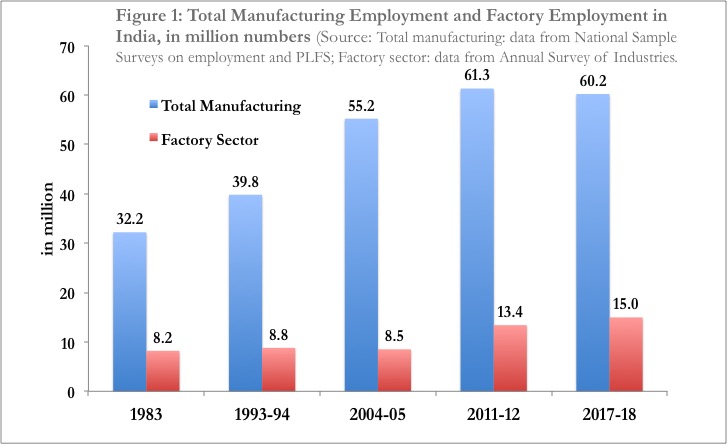
The above-referred figures on manufacturing employment comprise workers in both the organized as well as unorganized sectors. Organized manufacturing sector is almost identical with the factory sector, which comprises factories that employ more than 10 workers (and operate with the aid of electric power). According to data from Annual Survey of Industries, in 2017-18, India’s factory sector employed 15 million workers, which amounted to a quarter of all manufacturing workers (60.2 million) in the country in that year. At the same time, the remaining 75 per cent of India’s manufacturing workers were employed in small firms in the unorganized sector. The decline in manufacturing employment in India after 2011-12 occurred not in the factory sector, but in micro and small units that fall outside organized manufacturing.
Cheap Wages as Comparative Advantage
It appears that there are two aspects to the argument in the Economic Survey. One, India’s future industrial growth strategy should pivot exclusively around its advantage in cheap wages. The other side of this argument is that with its labour advantage (large size and low costs) alone, India will be able to replicate China’s success in large-scale labour-intensive manufacturing.
The above arguments are derived from the neoclassical theory of comparative advantage, which maintain that a labour suplus country like India should restrict its industrial development ambitions to labour-intensive sectors, such as garments or footwear. Much blame has been heaped on Indian planning for going against the comparative advantage theory. During the planning years, the country had consciously tried to build expertise in sectors such as machine making or space research, all of which needed capital and technology more critically than labour. Mainstream economists have criticized such import substitution policies for being the cause of India’s failure to create manufacturing employment in large numbers.
However, there is now a growing acknowledgement that it was not cheap wages but the supportive role of the state that proved crucial in successful industrializations, especially in the case of East Asian countries such as South Korea and now China. In the context of South Korea, Professor Alice Amsden had argued that the success in industrialization was achieved by going against the tenets of the comparative advantage theory — that is, with the government providing subsidies to selected firms and industries. Even the International Monetary Fund (IMF) in a paper it published in 2019 highlighted how the leading hand of the state directed domestic firms into technologically sophisticated industries in East Asia, in what it described as ‘Technology and Innovation Policy’.
As is well known, by the early 1990s, India abandoned its commitment to import substitution and shifted to a market-oriented strategy, welcoming exports and foreign investment. However, this has not led to any significant improvement in the prospects for India’s manufacturing. In 2017, manufacturing accounted for only 15.1 per cent of India’s GDP, compared to 29.3 per cent of China’s.
Mainstream economists and institutions such as the IMF and the World Bank have attributed India’s slow progress in manufacturing to what they perceive as continuing government intervention in the labour markets. In particular, they point out that the implementation of labour laws or minimum wages or the intervention by trade unions tend to increase workers’ negotiating power and make it difficult for employers to retrench workers.
However, the argument that labour laws and other interventions pushed up wages and undermined India’s comparative advantage in labour-intensive industries does not hold, at least from the 1990s onwards. Trade unionism has been on a decline in India since the early 1990s. Between 1999-2000 and 2014-15, directly employed workers accounted for only 33.5 per cent of the incremental employment in India’s factory sector, while the rest were contract workers or other employees who were outside the purview of the labour laws. Experiences from various industries show that employers find different ways to circumvent the existing labour regulations, while the authorities adopt a lax attitude towards implementing them. Chinju Johny, a researcher at the Indian Institute of Technology (IIT) Delhi, found that in Bangalore’s garment industry, the employers adopted many strategies to avoid payment of gratuity benefits to women workers (including persuading workers to terminate their current contract and re-join the same factory within a week or so on a new contract).
All of the above-mentioned factors led to labour’s reduced negotiating power relative to capital and to the informalization of labour relations even in the formal sector. In India’s factory sector, as a share of gross value added, profits increased sharply from 19.0% in 2000-01 to 53.8% in 2007-08, whereas workers’ wages declined from 15.5% to 9.2% during the same period.
Promotion for the big, but crisis in the small
The focus of government initiatives such as the “Make in India” programme or of policy discussions in the country in general has been about removing hurdles to and thereby promoting investments by the big firms, both foreign and domestic corporate. However, it is less known that the crisis of manufacturing employment in India has affected the micro and small firms much more than the big firms. Between 2004-05 and 2017-18, overall manufacturing employment in India increased from 55.2 million to 60.2 million – thus an increase of only 5.0 million new jobs. At the same time, employment in the factory sector (or organized manufacturing) alone increased by 6.5 million (from 8.5 million to 15 million) during this period (see Figure 1). Thus, between 2004-05 and 2017-18, the net increase in employment in the manufacturing sector (organized and unorganized sectors combined) was less than the net increase in employment in the organized manufacturing sector alone. Within the factory sector, research by Angarika Rakshit of IIT Delhi shows, 43 per cent of the incremental employment during the 2000-2015 period occurred in factories employing 500 or more workers.
The above evidence points to a sharp downward fall in the growth of employment in small and unorganized manufacturing firms in India from the mid-2000s onwards. This has been confirmed by evidence gathered by this author during visits (done over several years) to some of the major industrial cities in the country, including Coimbatore, Rajkot, Vadodara and Surat. Industries in these cities, — which include electrical machinery, pumps, automobile-ancillaries and textile machinery — have been characterized by relations between firms of varying sizes and at various levels in the value chain. At the base of this industrial ecosystem are a vast network of micro and small enterprises, which are suppliers of parts or components to the larger units. Typically, the micro units carry out one or more machining operations (using lathe, drilling or milling machines) required in the production of a particular part or component (this is popularly called ‘job work’).
Over the years, tiny and small firms have been hit the most in the crisis that has engulfed Indian manufacturing. At the root of this crisis has been the Indian state’s subdued intervention in industrial development in the form of investment and industrial policies.
Slowdown in Investment
The revival in India’s industrial and overall economic growth between the mid-and the late-2000s had been led by investments, especially private corporate sector investments. As per the data compiled by the World Bank, investment rates achieved by India and China had reached similar levels – around 40 per cent — by 2007. However, while the Chinese investment rate continued to escalate, India’s investment rates began to decline drastically from 2011 onwards. By 2011, gross capital formation (GCF) as a proportion of GDP rose to 47.7 per cent for China, as the state in China responded to the global financial crisis with massive investments in infrastructure and new technologies (see Figure 2). At the same time, according to national income estimates with 2011-12 as the base year, GCF as a proportion of GDP in India declined from 39.0 per cent in 2012-13 to 33.3 per cent only by 2016-17.
The stagnation in investment has resulted in severe supply-side bottlenecks in electricity, roads, and ports, which adversely affected the growth of the country’s manufacturing sector. The constraints in the infrastructure sector have raised the costs of Indian firms, especially micro, small and medium units, and have reduced the competitiveness of their products both in the domestic and export markets. Power shortages were the most serious constraint to industrial growth in Coimbatore between 2007 and 2014. The owner of a leading pump manufacturer in Coimbatore recounted the schedule of power cuts affecting his factory in January 2012: 10 am to 12 noon, 4 pm to 6 pm, 7.30 pm to 8.15 pm, and 9.45 pm to 10.30 pm. Power demand-supply shortages have reduced in India over the last few years, partly on account of the reduced demand for energy from industry.
Credit Shortage, Payment Delays, and GST Woes
Credit has been costly and not easily accessible from formal sources for manufacturing firms in India, especially the tiny and small ones. The financing of industrial development in India has been affected with the demise of development banking in the country from the 2000s onwards. At the same time, as commercial banks increased their lending to large-scale industries from the mid-2000s onwards, it led to the ballooning of their non-performing assets (NPAs). The most affected were tiny and small firms. As a proportion of non-food gross bank credit, advances to small-scale industries (SSIs) fell from 15.1 per cent in 1990-91 to 6.5 per cent in 2005-06, 5.7 per cent in 2010-11, and only 4.9 per cent in 2017-18 (see Figure 3). The owners of most micro enterprises I talked to, be they in Coimbatore or Rajkot, depended on their own personal or family savings for investment in machinery.
The financing of working capital requirements poses a heavy burden for the entrepreneurs of small firms. Typically, the bigger firms take up to six months to pay their dues to the small firms (for the parts and ancillaries supplied by the small to the bigger firms). As a result, entrepreneurs have to take loans at high interest rates to maintain their operations. Typically, working capital requirements are bigger during periods of recession due to the slowdown in orders and worsening in the non-payment of dues. On the other hand, banks are particularly reluctant to provide loans to firms during periods of recession (because of fears of loan defaults). Further, if a firm delays its repayment of loan (which is more likely during a recession) by more than a certain period, banks begin to charge penal interest rates.
The demonetization of high-value currency notes in November 2016 and the hasty introduction of goods and services tax (GST) in 2017 have aggravated the problems faced by tiny and small manufacturing firms in India. With these changes, many micro and small firms are, at least on paper, part of the formal sector. They have now received bank accounts and have to pay GST, but they still find it tough to access working capital loans. At the same time, GST payments have now become a new source of worry for the entrepreneurs. A small entrepreneur in Coimbatore told me in June 2019 that if he supplied a machinery-part worth, say, Rs.10 lakhs, he would have to pay GST amounting to Rs.1.8 lakh (GST at the rate of 18%) immediately, within a few days of the supply. The amount paid as GST would be reimbursed to him, but only later. However, the entrepreneur would have to wait up to six months to receive the payment (Rs.10 lakh) from his buyer. The result is that he would often have to take loans at high interest rates only to make the required GST payments.
India has reduced the tariffs on the import of several manufactured goods into the country from the 2000s onwards. The weighed average of import tariffs in India on capital goods declined from 94.8 per cent in 1991-92 to 23.1 per cent in 2001-02, and to 5.6 per cent in 2009-10. With the tariff reductions, there has been a large increase in imports into the country of machine tools, machinery, electronic and computer goods, and transport equipment. A study by the economist Smitha Francis shows how the reduction of tariffs without a coherent industrial policy has led to a huge jump in the imports of electronic goods into India.
The entry of multinational companies (MNCs) and the rise in imported components have reduced the opportunities for firms in the small-scale sector. For instance, small firms engaged in the power equipment industry (in Vadodara and Surat) noted that MNCs in this sector (such as Hitachi or ABB) prefer to work with other foreign firms (as suppliers), and not with small-scale Indian firms. They also pointed out how a major Indian private company in the power sector imported most of the machinery it needed while setting up its new plant. If the company had instead sourced its machinery from Indian firms, that would have provided a huge opportunity for small Indian firms in this sector.
The Chinese Experience
It is important for us to recognize that China achieved its success in manufacturing not though cheap wages alone. The Chinese government has played a key role in industrial promotion, especially in the areas of investment and innovation. Some estimates show that State-owned enterprises (SOEs) in China contribute between 23 and 28 per cent of GDP and 5 to 16 per cent of employment in the country. The state has been a central agent as the Chinese economy is now going through a transformation, from being an exporter of cheap goods to one based on domestic consumption and innovation. China is strategically deploying its large foreign exchange assets into initiatives such as the Asian Infrastructure Investment Bank (AIIB) and the ambitious ‘One Belt, One Road’ project. It is emerging as a global leader, even ahead of the U.S., in several new technologies, including artificial intelligence and renewable energy.
Despite the rise in wage costs, China continues to be the nucleus of the global and the East Asian production networks. This is because of China’s huge capabilities in finance, infrastructure and technologies, as well as its large home market. Manufacturing activities have been shifting from China to the Southeast Asian countries, mainly Vietnam and Cambodia, which are, in turn, heavily dependent on the Chinese economy for inputs and demand.
There are lessons for India in the way China has been focusing on its domestic markets. It is clear that with declining prospects for export-led development, India and other developing countries will need to turn more to their home markets for future growth.
India should not expect that it would emerge as a key player in labour-intensive industries on the strength of its cheap labour reserves alone, as the Economic Survey seems to suggest. It will have to inaugurate macroeconomic and industrial policies that will strengthen the capabilities of its domestic firms, provide assistance to small entrepreneurs, help develop indigenous technological capabilities, and above all assist in the creation of a home market.
 Labour Economy Development