Jayan Jose Thomas, 9 March 2023
The systematic way in which women have been targeted in the print media in Kerala is disturbing. The print media is not alone in this. Every inch of material that appears in the print can give rise to many hours of ‘prime-time’ gossip in the visual media as also vicious social media troll campaigns. It is not surprising that the young increasingly prefer to leave Kerala for higher studies and jobs. They are trying to escape the patriarchy and the conservatism that pervade their jealous neighborhoods — which the media discussions capture in all their ungainly details. Those who prefer to stay back and dare participate in the public sphere are subject to intense scrutiny, moral policing, and often ridicule. Much more so if they are women!
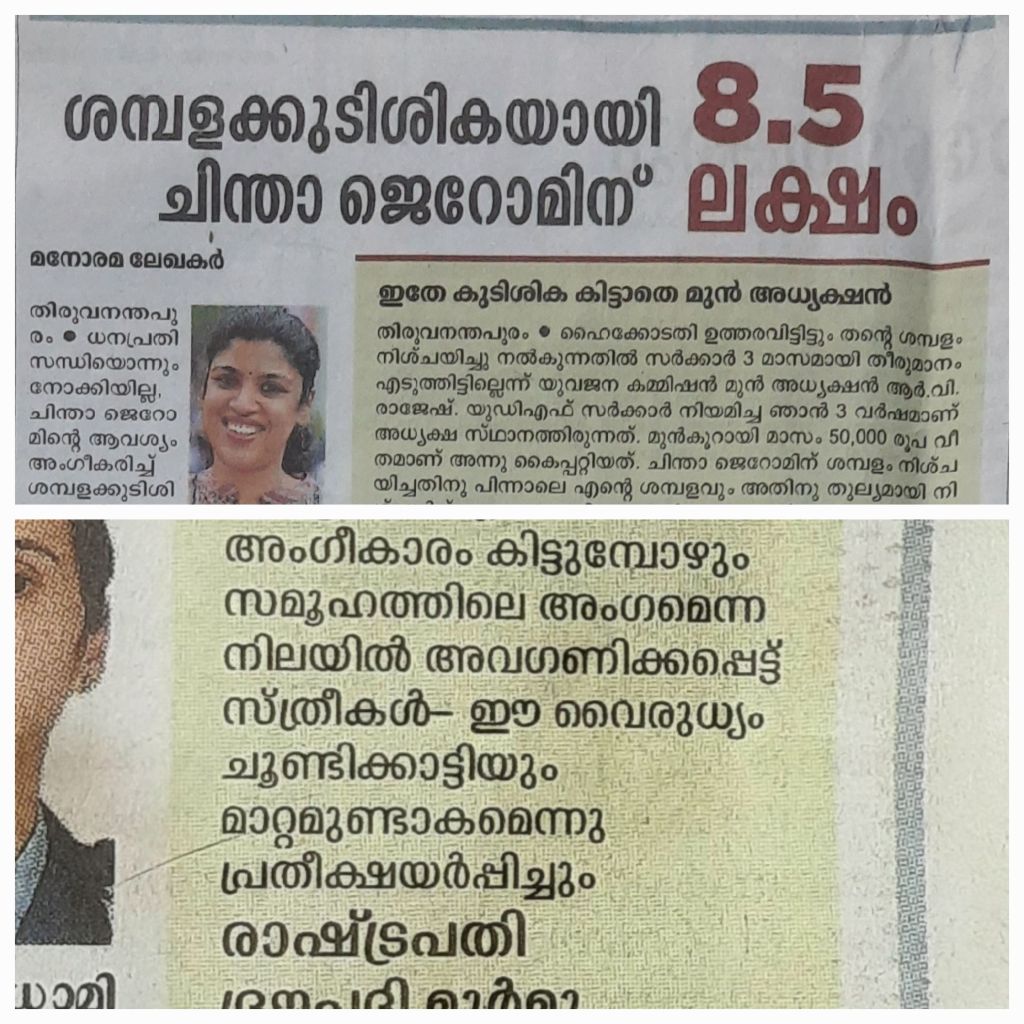
Consider the latest in a series of such attacks being launched from the pages of Malayalam’s leading daily over the last few months. A few weeks ago (on January 25), I came across this news item on the front page of that daily’s Delhi edition. It carried a picture of Ms. Chintha Jerome, Chairperson of the Kerala State Youth Commission, with the caption saying that she would receive Rs.8.5 lakh as salary arrears. At a first glance, the story and the picture, prominently placed on the very first page of the daily, would appear to suggest that the person in the story, a known Left activist, is the beneficiary of an out-of-turn largesse by the State government.
But on reading the article, I could not understand why that should have been news at all, let alone on the front page. There is no doubt that the Chairperson of a Commission at the State level is an important position, demanding several hours of work each day, including, one assumes, travel to different districts and meetings with officials and civil society members. The originally fixed salary for this position was Rs.50,000 per month, significantly less than what a middle-to-senior level government official would receive. The salary was later increased with retrospective effect, and that became front-page news!
The media could have raised the alarm if Ms. Chintha were not doing her job; it could have debated the roles and functions of the Chairperson when there exists a government department for youth affairs; in fact, it could have questioned why the government initially chose to fix a relatively low salary for such a crucial position (was it because the appointee was a young woman?). Unfortunately, the media did not seem to have any interest in addressing these larger issues. Instead, it chose to turn the spotlight on Ms. Chintha herself, knowing fully well that doing so would gather more eyeballs, and that by raising some vague doubts, she could become a soft enough target for further attacks.
The ploy seemed to have worked well. All pandemonium broke loose when an error was found in Ms. Chintha’s Ph.D. thesis, and that became a matter for front-page news for a few days. In her thesis on cinema and ideology, a well-known poem in Malayalam was mistakenly attributed to a different author. I cannot comment on the seriousness of the error as I have not read the thesis and I am not a subject expert either. But there were many who questioned the quality of her thesis in print and social media platforms. Not many of them, to my knowledge, were subject experts or had read the thesis.
As someone who holds a Ph.D. myself, and has guided (or is guiding) a few Ph.D. candidates, I can imagine how frustrating it would be for a scholar to see her work being ridiculed by people who have not even seen it. It is not unusual that a few typographical or other errors are found in a thesis even after several rounds of editing – just as errors do occur in other printed documents too, including newspapers. Depending on how serious the errors are, a thesis examination committee may ask a candidate to revise a few sections or even chapters of a thesis. In exceptional cases, a thesis may even get rejected. But these are typically decisions taken after calm and objective deliberations, by persons who have carefully gone through the research.
There have been similar attacks against another woman academic, Dr.Priya Varghese, and these featured prominently in the print media between August and November 2022. The media started discussing her case when Dr. Priya, who joined Kannur University as an Assistant Professor in 2012, was promoted to Associate Professor position. The opposition political parties intervened too as Dr.Priya is related – by marriage – to a prominent leader of the ruling party. One of the questions the media discussed in great detail was whether she was qualified enough to be an Associate Professor. Would the period during which she completed her Ph.D. and worked in the Kerala Institute of Language, while still being on deputation from Kannur University, be counted as relevant experience for promotion? On such questions, the rules are different across various academic institutions in India and abroad. It is important to have a public discussion to gain greater clarity on these questions in the Kerala context.
But unfortunately, the media was not interested in an objective discussion. Instead, it focused exclusively on Dr. Priya and her personal details, mainly the fact that she is the wife of a CPI(M) leader. It did not care that as an academic for more than a decade, Dr. Priya has her own agency and accomplishments. Interestingly, the attacks stopped (again in the Delhi edition of the leading daily I read!) almost immediately once the World Cup Football kicked in, which provided sufficient material for front-page photographs and news.
It is true that the women who were recently targeted by the media were some way or the other connected to the ruling Left Front. People who gleefully shared the trolls and memes about these women may have done so as they are critical of the government policies and were venting their frustration. But that could be a slippery slope. We may have a different political formation tomorrow but public discussions in the State could still be obsessing about (some other) women and their personal lives rather than real issues.
Jayan Jose Thomas
 Labour Economy Development